Track 2 of 7 · 4 min read · Updated
What a mushroom trip feels like, from the senses to time and thought
What changes during a magic mushroom trip: colours and patterns, sound, the sense of time, thinking, emotions and the body, phase by phase and with sources.
A mushroom trip changes how you see, hear and think: colours become more intense, patterns appear on plain surfaces, time usually slows down and thoughts jump between unusual connections. Those are the effects the Jellinek addiction centre describes, and they are what most people mean by "tripping". The body takes part too, with nausea, wide pupils and a mildly raised heart rate. How strong each of these gets depends mostly on the dose, and the mix shifts as the trip moves from come-up to peak to comedown.
This page describes the acute effects only, during the hours of the trip. The timeline gives the clock; the day after covers what lingers.
Seeing: colour, texture and movement
The visual changes are the best-known part. Jellinek describes colours that become more intense, patterns appearing on a white wall and faces that look different. In practice they build up in a fairly fixed order:
- Come-up. Light seems brighter or warmer. Edges and textures stand out: the grain of a table, the weave of a curtain.
- Peak. Surfaces seem to breathe or flow. Patterns, often geometric and repeating, lie over walls and floors. With eyes closed, colourful shapes and scenes can appear.
- Waves and comedown. The patterns come and go, then fade. Colours stay a little richer for a while.
Most people know at all times that these are effects of what they took. At higher doses that sense of distance can weaken, which is one reason a sober sitter is advised.
Hearing and music
Sound changes as much as sight, though it gets less attention. FRANK, the UK information service, lists distortion of sound among the typical effects. Music often feels closer, more layered and more emotional, which is why so many people plan a playlist. Sudden or harsh noises, such as a doorbell, traffic or a phone, can feel intrusive for the same reason.
Time
Jellinek notes that time usually seems to run much more slowly: seconds can feel like minutes, and in extreme cases time seems to stand still. Sometimes it races instead. This matters practically. Twenty minutes of a difficult feeling can feel endless, and watching the clock during the come-up makes the wait seem longer than it is. Knowing the phases in advance helps you place where you are.
Thinking
During a trip, thinking becomes associative. Jellinek describes unusual connections that can feel like surprising insights, and also thoughts that come back in loops. Following a conversation or a film plot gets harder. In a Swiss study, medium and high doses of psilocybin cut performance on an attention test by about half compared with a placebo (Hasler et al. 2004).
That loss of focus is the reason not to plan anything practical. Cooking with gas, handling money, answering messages from work or going into traffic do not fit the middle hours of a trip.
Emotions
Mushrooms tend to amplify the mood you already have. Jellinek puts it plainly: if you feel bad, you can become anxious; if you feel good, you may get a relaxed and cheerful feeling. FRANK lists both sides: giggly and excited, but also confused, paranoid, anxious or overwhelmed. Laughter and tears can sit within the same hour.
At higher doses, some people report a sense of unity, timelessness or awe that researchers call a "mystical-type" experience and measure with a standard questionnaire (Barrett et al. 2015). Others meet fear or grief instead. Neither can be ordered in advance.
The body
Jellinek lists the physical effects: dilated pupils, a mild rise in heart rate and blood pressure, problems with balance, nausea, vomiting and a dry mouth. Nausea belongs mainly to the come-up and usually passes. Stumbling and poor balance are a reason to stay somewhere without stairs, water or traffic close by.
How the effects change with dose
Dose matters more than anything else. In an analysis of 409 psilocybin sessions in Swiss lab studies, dose was the strongest predictor of every measured effect, from visual changes to anxiety (Studerus et al. 2012). The same study found that personality and mood before taking it also played a measurable part.
| Strength | What people usually describe |
|---|---|
| Light | Brighter colours, a cheerful mood, music feels better, thinking stays mostly clear. |
| Moderate | Clear visual patterns, slowed time, strong emotions, conversation becomes harder. |
| Strong | Surroundings and sense of self dissolve, little contact with the room, higher chance of fear and confusion. |
With mushrooms you cannot read the dose off the weight alone, because the content varies a lot between species, batches and single mushrooms. The timeline page gives the measured range.
In the Netherlands: from mild to strong
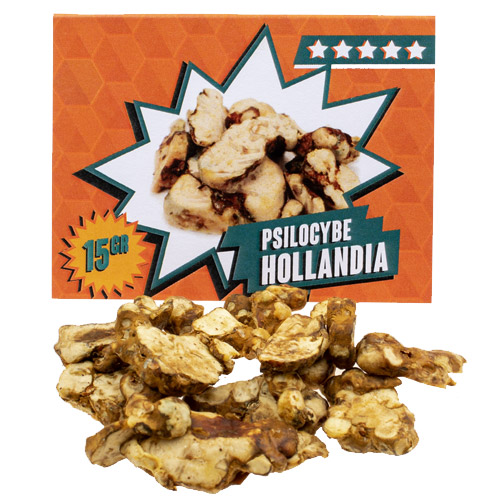
In the Netherlands, fresh magic truffles are the legal alternative, and Dutch-Smart grades its strains by strength. Mexicana is described by the shop as mild with almost no visual effects at a normal dose, Atlantis as moderate to strong and Hollandia as very strong and suited to people with some experience. The full scale is in the choice guide.


Single · Dutch-Smart
Atlantis Magic Truffles
Shop rating: moderate to strong
€14.95View at Dutch-Smart